Language

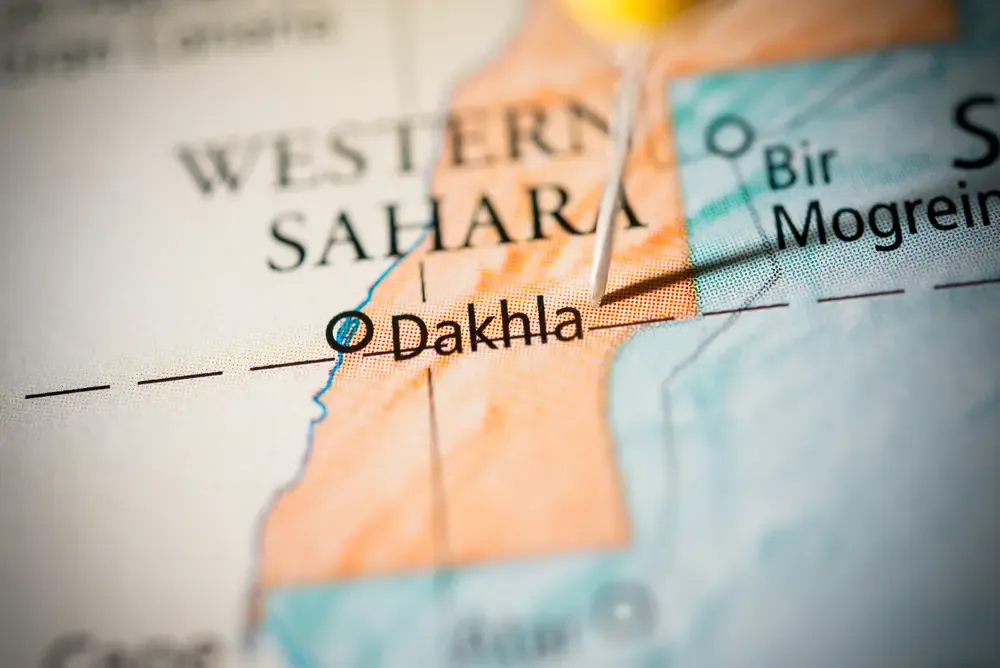
Dakhla looks impossibly remote on a map. A thin finger of sand sticking out into the Atlantic on the edge of the Sahara, roughly 1,500 kilometres of road south of Marrakech, with not much on either side of it for hours in any direction.
That map is enough to put some riders off booking. I've had the same conversation dozens of times: the wind sounds incredible, but how on earth do you actually get there, and is it sensible to go?
The honest answer is that it's a long travel day but a surprisingly straightforward one. Usually one connection, sometimes none at all. The parts people get wrong are almost never the flights. They're the baggage fees, the cash, and the insurance.
So here's the whole thing, start to finish. Routes, the airport, the transfer, gear, documents, money, and a straight answer on safety.
If you're still choosing the destination rather than the flight, start with our complete Dakhla kite guide and come back here once you're sold.
You get to Dakhla by flying into Dakhla Airport (VIL), either direct from France, Spain, or the Canary Islands, or with one connection through Casablanca on Royal Air Maroc. The airport sits about 5 kilometres north of the city, and the lagoon camps are a further 30 to 40 minutes' drive. There is no train, and the bus from Agadir takes around 18 hours.
In practice, that's pretty much the decision. Direct if a route happens to run near you; otherwise, it's through Casablanca.
Here's what's flying at the moment:
One thing worth flagging before you start hunting for the perfect route: several of these are seasonal, and they thin out in winter. If you're traveling in the off-season between November and February, plan on Casablanca and don't spend too long looking for a clever direct option that probably isn't there.

Direct flights to Dakhla are operated by Transavia and Royal Air Maroc from Paris Orly, Ryanair from Madrid, Binter Canarias from Las Palmas, and Transavia seasonally from Marseille and Bordeaux. Everything else routes through Casablanca.
France is the easiest place in Europe to start. Paris Orly has the most reliable service, with Royal Air Maroc running it year-round and Transavia adding its own flights. The flight takes about four and a half hours. Transavia also runs Marseille and Bordeaux seasonally.
I'd assumed a "direct flight to the Sahara" would mean a grim charter at four in the morning. Instead, it's a normal short-haul flight at a normal time of day, and you land in daylight.
The catch is that “seasonal” really does mean “seasonal”. I've watched people find the Marseille route in July, assume it runs in January, and end up rebooking the whole trip through Casablanca at short notice.
Ryanair opened Madrid to Dakhla in 2025, twice weekly and seasonally, and it's the first proper link between Dakhla and mainland Spain. It's cheap and takes under three hours.
Binter Canarias flies from Las Palmas in an hour and fifteen minutes, which is the shortest hop to Dakhla from anywhere. On paper, it's the perfect back door: fly to Gran Canaria on whatever is cheap from your home airport, then hop across.
In practice, twice a week is twice a week. Unless your dates line up, you're potentially adding a night in Las Palmas at each end, and that stops being a bargain quite quickly. I've done it, I'd do it again, but only when the days matched without contortions.
Royal Air Maroc operates Casablanca-Dakhla flights around a dozen times a week, on every day of the week, and the flight takes 2 hours 20 minutes. Since Casablanca connects to most of Europe and a good part of North America, this is the route that works for most people who don't have a useful direct flight.
It's also the one I trust most when I'm traveling with a board bag, because the whole journey sits on one ticket with one airline. If a connection goes wrong, it's their problem, not yours.
Give yourself a real connection window rather than the legal minimum. Oversized bags take longer to appear and longer to be moved, and a 70-minute transfer that looks fine on the booking page is exactly the sort of connection that can leave you in Dakhla while your gear spends another day in Casablanca.
There are no direct flights from the UK. You connect, most often through Casablanca, sometimes through Paris or Madrid, and you should plan on a full travel day door to door.
That sounds worse than it actually is. It's one connection, and you're on the lagoon by evening, which is less faff than plenty of European trips I've made where the flight was shorter but getting from the airport wasn't.

Dakhla Airport (VIL) is a single small terminal about 5 kilometres north of the city centre, with one baggage belt, a handful of taxis outside, and a passport check on arrival. From landing to standing outside with your bags usually takes well under half an hour.
You'll fill in an arrival card, either on the plane or at the desk, and you want to get your passport physically stamped. Make sure you get the stamp, and check it before you walk away. It's the one document that proves when you entered, and leaving without one can turn into a slow conversation.
The thing to sort before you walk out is money, because there's very little at the airport and the camps are not the sort of places with a cash machine in reception. More on that below.
I keep expecting the sort of small-airport chaos I've hit elsewhere in similar places. It hasn't happened yet. It's quiet, slightly sleepy, and the whole arrival takes less time than the walk between terminals at Casablanca.
Most riders reach the lagoon by a pre-arranged transfer. Many camps and hotels provide a free shuttle from Dakhla Airport, and the drive to the lagoon takes roughly 30 to 40 minutes. Taxis wait outside the terminal, don't use meters, and cost around 50 to 70 dirhams to get into the city itself.
Arrange the pickup before you fly. If there's one bit of arrival admin worth doing properly, it's this. Confirm it in writing, give them your flight number, and confirm it again a couple of days out. Flight times shift, and messages do occasionally get missed or disappear.

If you're taking a taxi instead, agree on the fare before you get in, not after. It's not about assuming someone is going to fleece you. But, there's no meter to appeal to, and it's a much easier conversation at the onset than at the destination.
Where you're going matters here too, and it's worth reading up on where the camps sit relative to the city before you book. Stay in town, and that 30-to-40-minute drive isn't just your airport transfer. You'll be doing it every time you head out to the lagoon.
Mirage is a kite school rather than a camp, so we work with riders staying anywhere on the peninsula or in town. If you're not sure which setup suits you, ask us before you book the room, not after.
Kite gear travels as sports equipment, and this is one part of the trip where it's worth reading the airline rules properly rather than assuming they'll all be roughly the same. They aren't. Royal Air Maroc carries a kitesurf board free of charge within 23 kg and 220 x 40 x 40 cm, counting as one piece of checked baggage. Transavia charges around €52 each way for one water sports bag up to 32 kg. Binter Canarias handles it as special baggage that has to be declared in advance.
Check that again if you're mixing airlines, because this is where the costs can sneak up on you. The same bag can be free on one leg of your trip and come with a chunky fee on the next.
A few things I've learned carrying gear down here more times than I'd like to admit:

If you'd rather not deal with the baggage rules at all, renting here is a genuine option, and plenty of people do a first trip that way. It costs more across a fortnight than flying your own kit, so you're paying for convenience rather than saving money. It's also a fairly painless way to find out how you actually get on with the strong wind on the lagoon before committing a board bag to it.
You can reach Dakhla overland on the N1 coast road. Supratours runs a bus from Agadir that takes around 18 hours, and driving the same route from Agadir through Tan-Tan, Laayoune, and Boujdour is a two-day trip that most people break at Laayoune.
Expect police checkpoints, and expect a lot of them. There are roughly four between Laayoune and Dakhla alone, more if you're coming the whole way down from Agadir, and each one wants your name, nationality, passport number, occupation, vehicle registration, and destination.
The trick every overland regular uses is a stack of printed slips, called a fiche, with all of that already filled in. Hand one over, and you’re usually waved on. Without them you're writing the same details out by hand, in the sun, eight times in a day.

If you're driving, you need the 1968 version of the international driving permit alongside your own licence, and you have to get it before you leave. You can't buy one once you're in Morocco.
Honestly? Unless the drive itself is part of why you're going, I'd fly. I enjoyed doing it once, in a van, with a week to spare and no schedule. I wouldn't do it to save money on a ten-day kite trip. Eighteen hours on a bus is also a lot of holiday to give up when you could already be at the lagoon.

Most travelers do not need a visa. UK, EU, US, Canadian, and Australian passport holders can enter Morocco and the Moroccan-administered parts of Western Sahara without a visa for up to 90 days. You'll need a passport valid for your stay, though many airlines will want to see six months and it's simpler not to argue about it.
Two practical notes. Independent overland travelers can occasionally be turned back at land borders, which is another small argument for flying. And check that entry stamp before you leave the airport. It's what matters again when it's time to leave the country.
Check your own nationality's position before you book rather than trusting a summary written for someone else's passport. Rules change, and this one is easy to confirm in five minutes.
The Moroccan dirham is a closed currency, so you can't buy it before you travel. You withdraw it from an ATM once you arrive, and Moroccan banks now add a flat fee of about 35 dirhams per foreign-card withdrawal, often with a cap of around 2,000 dirhams per pull.
It's the combination that catches you out: small cap, fixed fee per withdrawal, and not much in the way of cash machines out at the lagoon. Word of advice: take out more than you think you'll need. What seems like a reasonable withdrawal can suddenly seem a bit optimistic when you're 30 or 40 minutes away, so take out more than feels necessary. It's better than the alternatives.
Cards work in the larger hotels and restaurants in the city. Out on the peninsula, for a taxi, a guide, a lunch, or a tip, though, it's cash, or it's nothing.

I always draw the maximum on arrival in the city, and only change a small amount at the airport itself. It's the one bit of Dakhla admin I've never got completely right, but having too much cash at the end of a trip is better than not enough while still out at the camps.
Dakhla is generally a calm, low-crime city, and it isn't inside either of the areas the UK Foreign Office advises against traveling to in Western Sahara. Both of those areas are defined by their distance from the Berm, the militarised boundary running down the middle of the territory. One covers everything within 40 kilometres north and west of that line, including the city of Es Semara. The other covers the territory to its south and east. Dakhla sits on the Atlantic coast, a long way west of the Berm. So, Dakhla is in neither.
That distinction matters because searching for "Western Sahara" brings up travel warnings that can look as though they apply to Dakhla when they don't.
The situation on the ground is less dramatic than the search results can make it sound. This is a disputed territory under Moroccan administration, access is closely monitored, and there are checkpoints. Avoid political gatherings and demonstrations. Read the current advice yourself before you book, as the guidance can change.
The risks more likely to affect an actual trip are the ordinary travel ones. Driving at night on unlit desert roads is the genuinely dangerous activity here, not anything geopolitical. Medical facilities in Dakhla cover the basics, with a hospital, clinics, and pharmacies, but anything serious means an evacuation to mainland Morocco or the Canary Islands. The emergency number for an ambulance is 150.
I've never felt unsafe here, at any hour, walking back through town after dinner. I have felt stupid setting off on a long drive at dusk, and that's the risk I'd be quicker to warn someone about.

Buy travel insurance that specifically covers kitesurfing by name and includes medical evacuation, and check how your insurer treats Western Sahara.
If there's one paragraph in this guide worth reading twice, it's this one. There are two separate catches. Standard policies routinely exclude kitesurfing as a hazardous activity, so the cover you already have for a beach holiday may be worth nothing the moment you're on the water. Separately, some insurers exclude Western Sahara as a territory, or void cover for travel against government advice, even where the advice doesn't cover the part you're visiting.
Ask your insurer both questions specifically, and get both answers in writing. It takes one phone call. Given that anything complicated means a flight to Las Palmas or Casablanca, the evacuation cover is something you may actually need, not just another line buried in the policy.
I used to treat insurance as a box to tick on the way to the checkout. Then I watched someone break a foot on a rest day, not even while kiting, and spend the rest of their trip discovering what their policy didn't say.
Book flights two to four months ahead for a peak-season trip. The wind runs strongest from June to August, September is the best all-round month, and March to May and October are the calmer shoulder months. Camps fill early from June through September, and the direct flight options are at their thinnest from November to February.
There's a slightly awkward overlap here. The months when you have the most choice of flights are also the months when beds disappear fastest. If you're going in peak season, sort the bed and the flight in the same week, not a month apart.
If your dates are flexible, the shoulder months make the logistics easier: cheaper flights, more space, and no scramble for a transfer. You're trading some wind for it, and whether that's a good deal depends entirely on what you're going for. There's a fuller breakdown of what each month actually delivers if you're still deciding.

Looking back at the trips where something went wrong getting here, it's never been the route. It was a 70-minute connection in Casablanca with a board bag. It was assuming a seasonal flight ran all year. It was realising I had only 400 dirhams in my pocket on a Sunday out at the camps.
So if I were booking this afternoon, I'd take the Casablanca connection with a long layover, declare the board bag at the point of booking, confirm the airport pickup twice, draw a solid wad of cash in the city, and make one phone call to my insurer about kitesurfing and Western Sahara.
Five things. None of them is difficult, and together they cover nearly everything I've seen go sideways.
The journey itself is the easy part. It takes longer than you'd like, but once you've done the boring bits properly, it's much simpler than the map makes it look.
Still working out the route that suits your dates and your gear? Get in touch with us, and we'd love to help you plan it.