Language

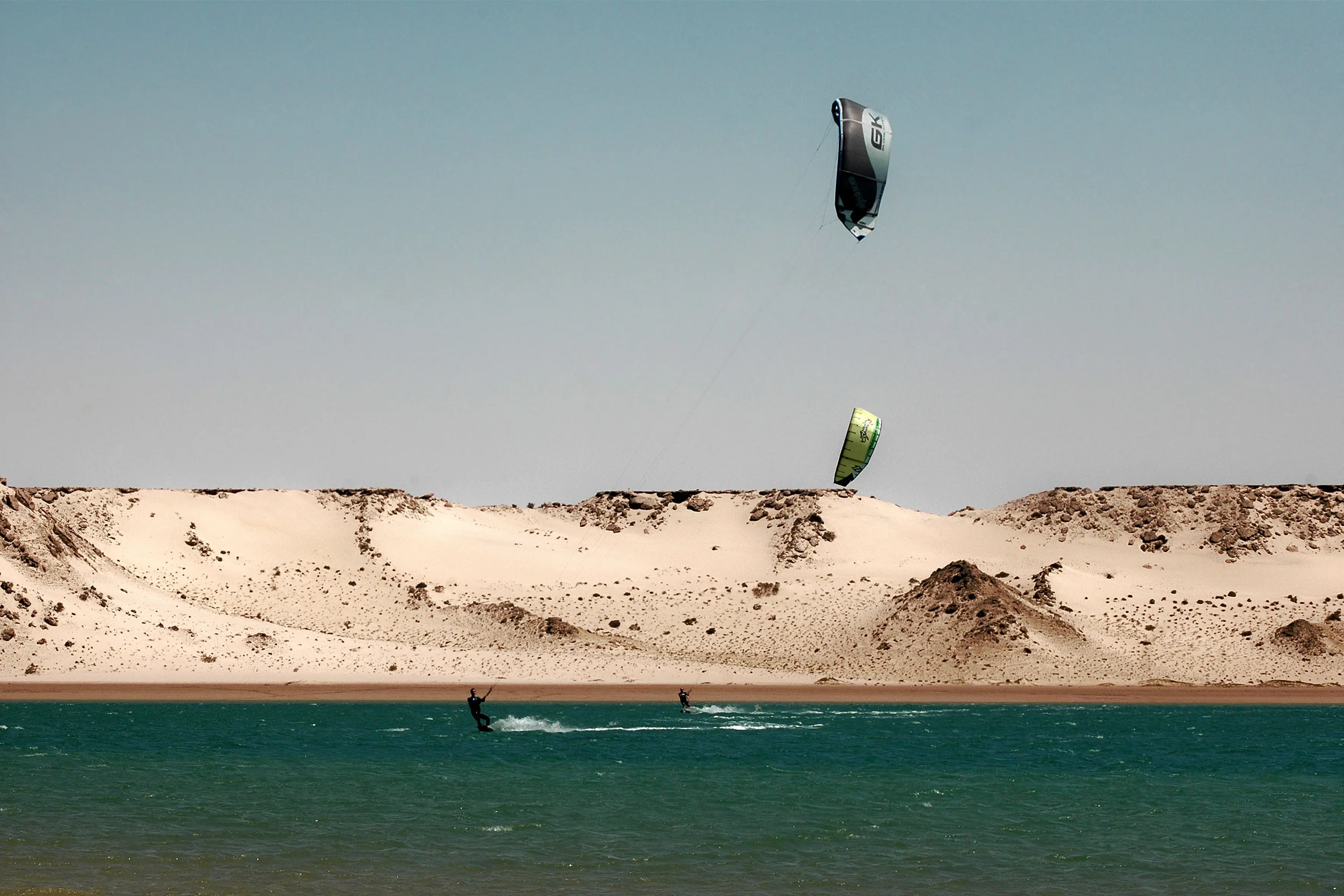
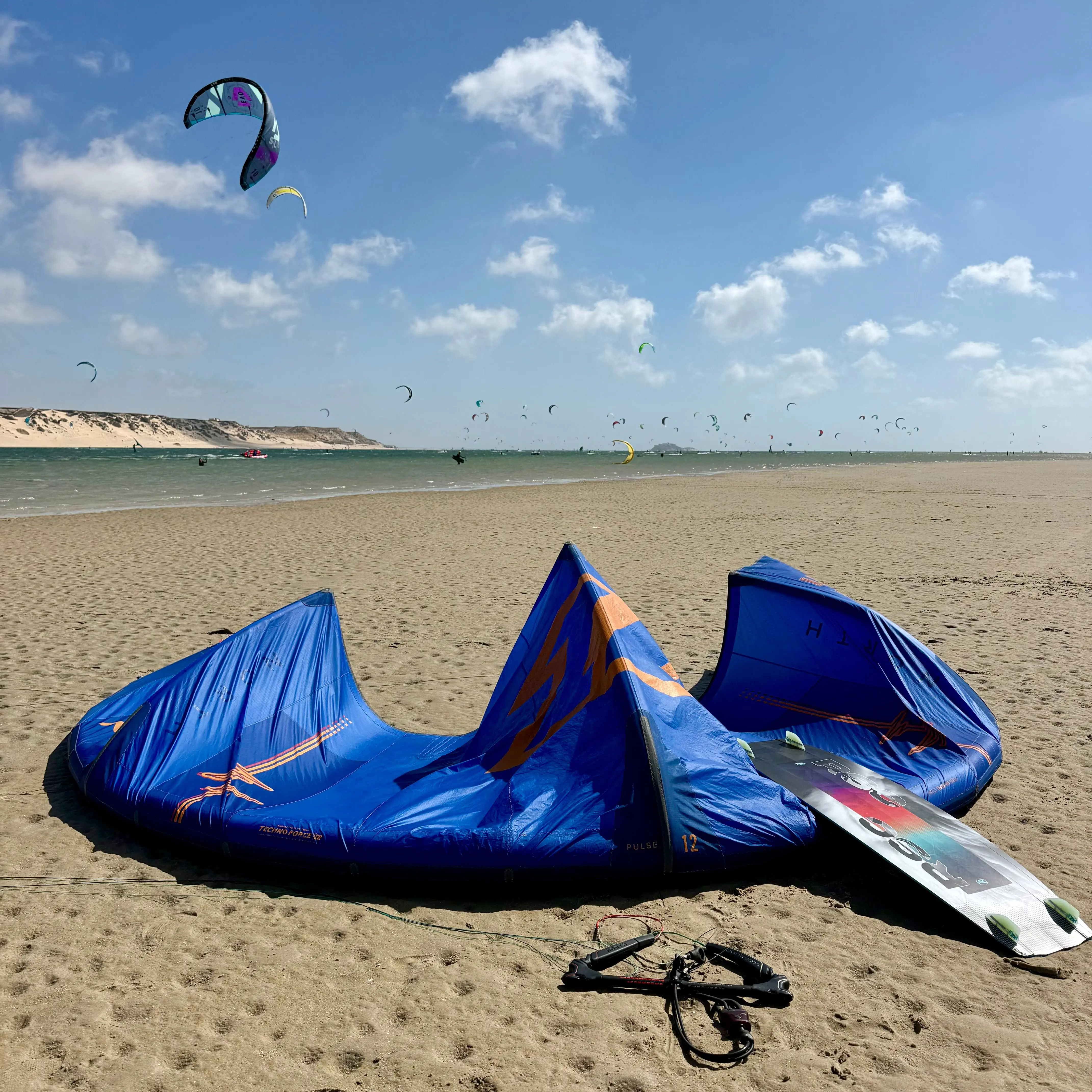
Most kite destinations give you one spot and a car park. Dakhla gives you a 45-kilometre lagoon, a handful of Atlantic wave breaks, and a scattering of hidden flats you can only reach on a downwinder.
That's the appeal, and it's also the confusing part. On my first trip, I spent the better part of a week riding the same patch of water in front of the camp before I worked out what else was within reach. Nobody had drawn me a map.
So here's the map. Every spot worth knowing, what the water actually does, who each one suits, and the tide and access details that decide whether you get a session or a long drive for nothing.
Dakhla's kitesurfing spots split into two groups: flat water on the sheltered lagoon side, and waves on the exposed Atlantic side. Beginners and most intermediates should ride the Dakhla Lagoon, which offers flat, shallow water and reliable side-shore wind.
Freestylers head to the Speed Spot at low tide, wave riders go to Foum Labouir or La Sarga on the Atlantic side, and the White Dune is best reached as a downwinder at high tide.
Here's the whole peninsula at a glance:
This is the bit that took me the longest to picture, and it makes everything else make sense.
Dakhla sits on a thin peninsula. The sheltered lagoon runs down the inside of it, and the open Atlantic hammers the outside. The camps are strung along the inner shore roughly 30 to 40 minutes' drive south of Dakhla city.
Everything flat is on the lagoon side. Everything with proper surf is on the ocean side. The wind blows from the north or north-east almost every day, which means it runs down the length of the lagoon as a side-shore breeze. That steady direction is one of those things you stop thinking about after a day or two, but it quietly makes the whole place work. It's also why the downwinders all point in the same direction.
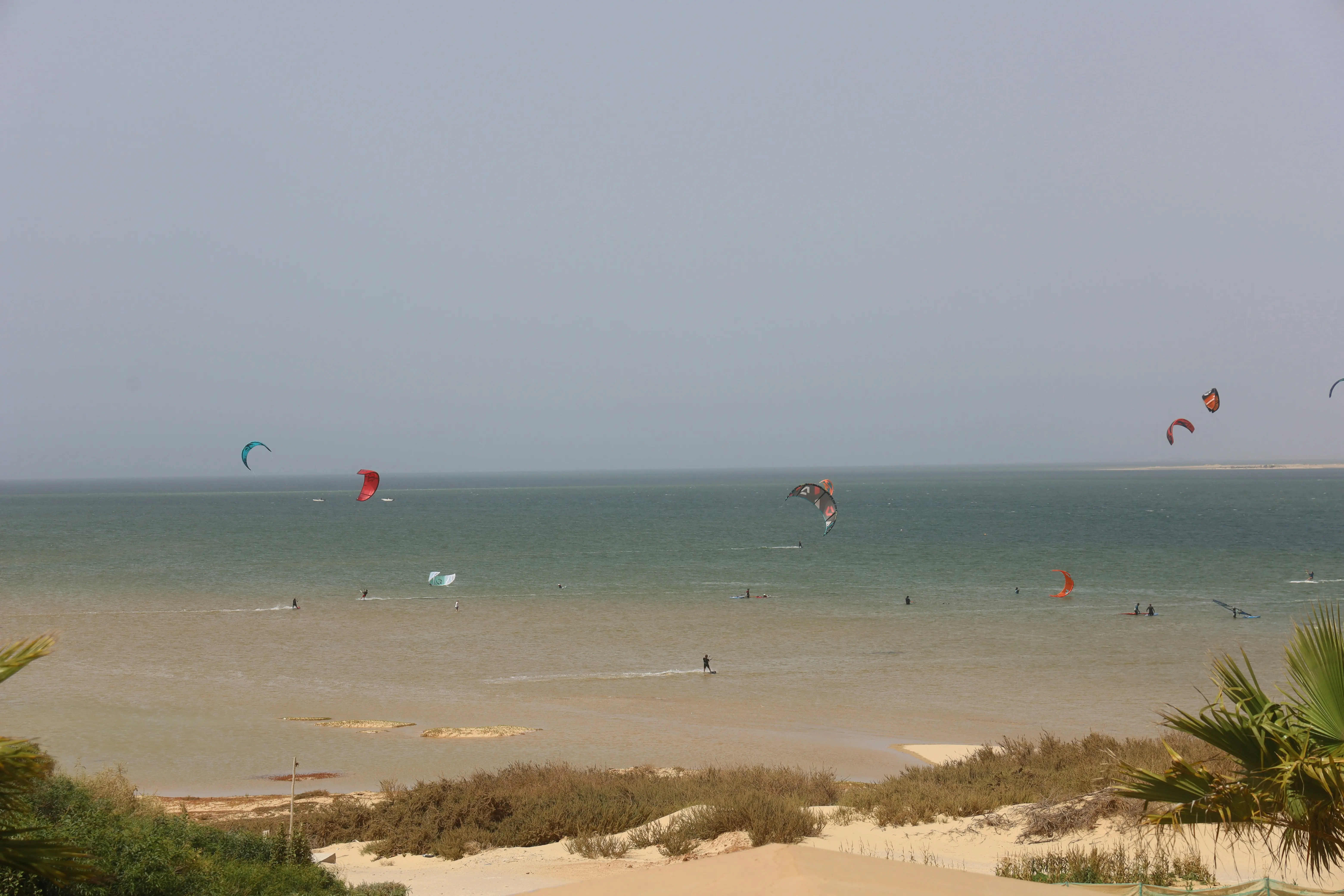
Once that clicked, I stopped thinking of these as six separate places and started thinking of them as one long ride with different rooms in it.
You aren't really choosing between isolated spots. You're choosing which part of the peninsula matches the kind of session you want that day.
The Dakhla Lagoon is the main kitesurfing spot in Dakhla: a 45-kilometre stretch of shallow, flat water sheltered from Atlantic swell, with side-shore N/NE wind and standing-depth sections that make it suitable for every level from first lesson to freestyle.
It's the reason people come, and it's where you'll spend most of your trip, whether you planned to or not.
The scale doesn't land until you're on it. The flat water runs so far that you can ride in one direction for twenty minutes and still not reach the end, and there's a deeper central channel for anyone on a foil. In lighter wind, it's glassy. When it's properly blowing, you'll get some chop, but there's no swell and no rocks, so a crash costs you nothing but dignity.
The first time I rode there, I kept expecting to reach the far side. Then I realised I'd barely made a dent in the lagoon! It feels much bigger from the water than it ever looks on a map.
For learning, it's close to ideal. Shallow, warm enough, and so wide that beginners and freestylers genuinely don't get in each other's way. I've watched someone taking their first waterstart about two hundred metres from someone landing handle-passes, and neither noticed the other. That's surprisingly rare!
At plenty of beginner spots, everyone ends up squeezed into the same stretch of water, but here it's easy to find your own space after a short ride.
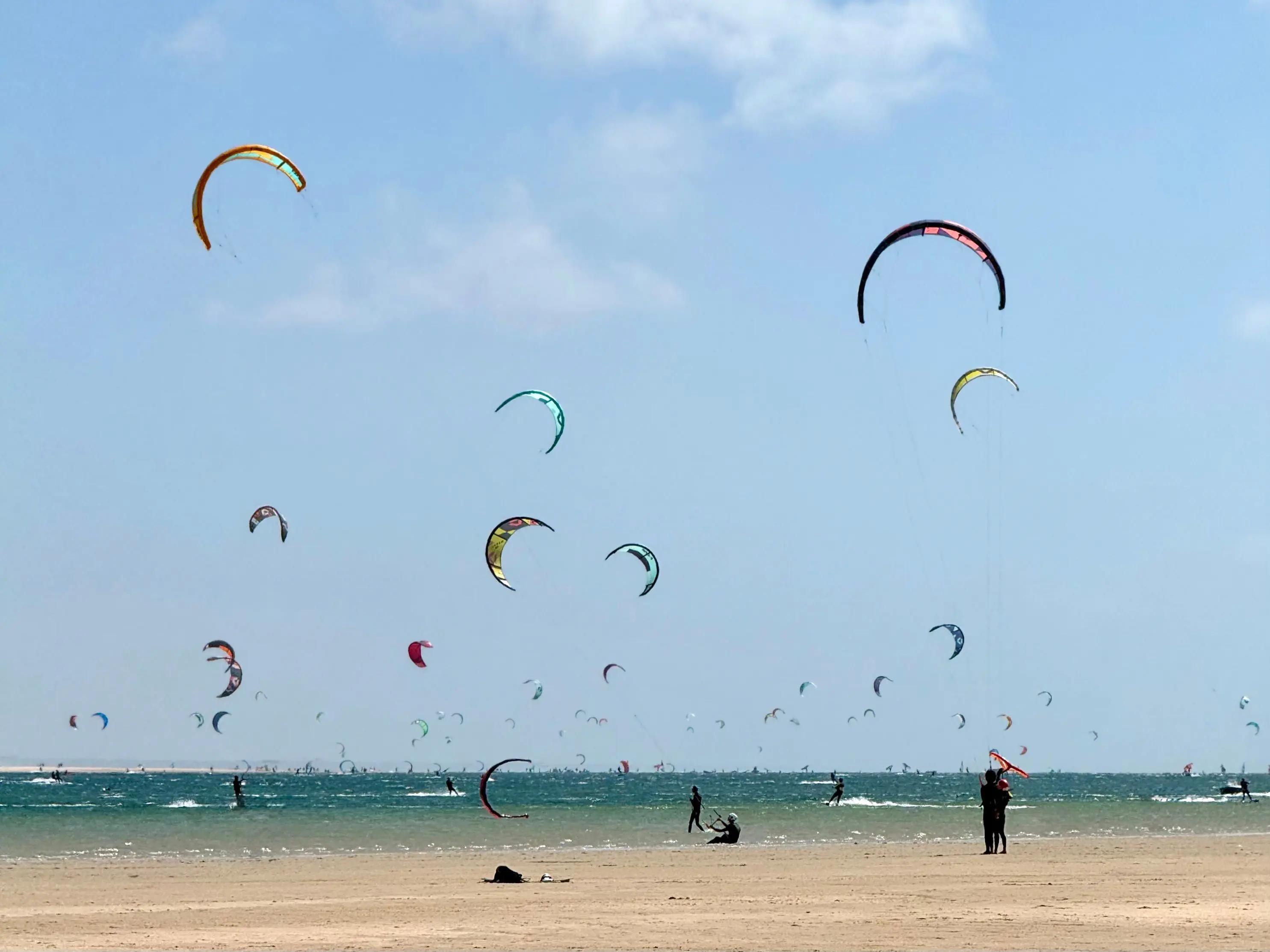
The honest downside is the crowding, and it's very localised. The water directly in front of the busiest camps can get genuinely congested in peak season, with schools, rental groups, and rescue boats all sharing one strip. Ride 300 metres upwind or down the shoreline, and it empties out completely.
I've seen people write off the lagoon after never venturing beyond the busiest launch. Five minutes later, the traffic all but disappears.
Lagoon quick facts:
The Speed Spot is a low-tide flat-water spot a few kilometres from the main lagoon. It’s reached by downwinder, boat, or 4x4. A sandbank shelters the water surface at low tide, making it the best spot in Dakhla for freestyle and speed runs, and it suits intermediate and advanced riders.
This is the one Dakhla's reputation was built on, and the first time I rode it, I understood why people won't stop talking about it.
The water goes glassy. Not "quite flat" but properly glassy, the kind where you can see the bottom moving past underneath you, and there's simply nothing to trip a landing.
I honestly thought people were exaggerating until I got there! After a few runs, I understood the fuss. Landing tricks suddenly felt a little less intimidating because the water stayed so predictable. Most camps run trips out when the tide allows.
The catch is that the tide has to line up. This is a low-tide spot and only a low-tide spot, so your window is a couple of hours, and it moves an hour later every day. I've had a trip where the good tides all fell at 7am, and I only made it out twice in a week.
Check the tide table before you get your hopes up. It's one of those lessons you usually only need once. After that, checking the tide becomes part of your morning without really thinking about it.
Best for: intermediates working on their first unhooked tricks, freestylers, and anyone chasing a speed run.
The White Dune is a tall sand dune on the Dakhla lagoon with a patch of sheltered flat water in its lee. It is a high-tide spot, usually ridden as a downwinder from the lagoon camps with a 4x4 pickup at the end, and it suits intermediate riders and above.
It's the postcard, and it earns it.
The dune drops straight into the water with the whole of the Sahara stacked up behind it. Riders jump off the crest side and land in the calm below. I'd seen hundreds of photos before I went, so I wasn't expecting to be surprised. Somehow it still looked bigger in person.
We ended up hanging around for a while before riding on because nobody seemed to be in a hurry to leave. Even if you never do that, riding underneath it at golden hour is the session you'll still be describing months later.
Note which way the tide runs here, because it catches out people who've just got their heads around the Speed Spot. This one wants high water, not low. At low tide, there simply isn't enough depth to work with. I've heard more than one rider mix those two spots up, and it's an easy mistake if it's your first trip.
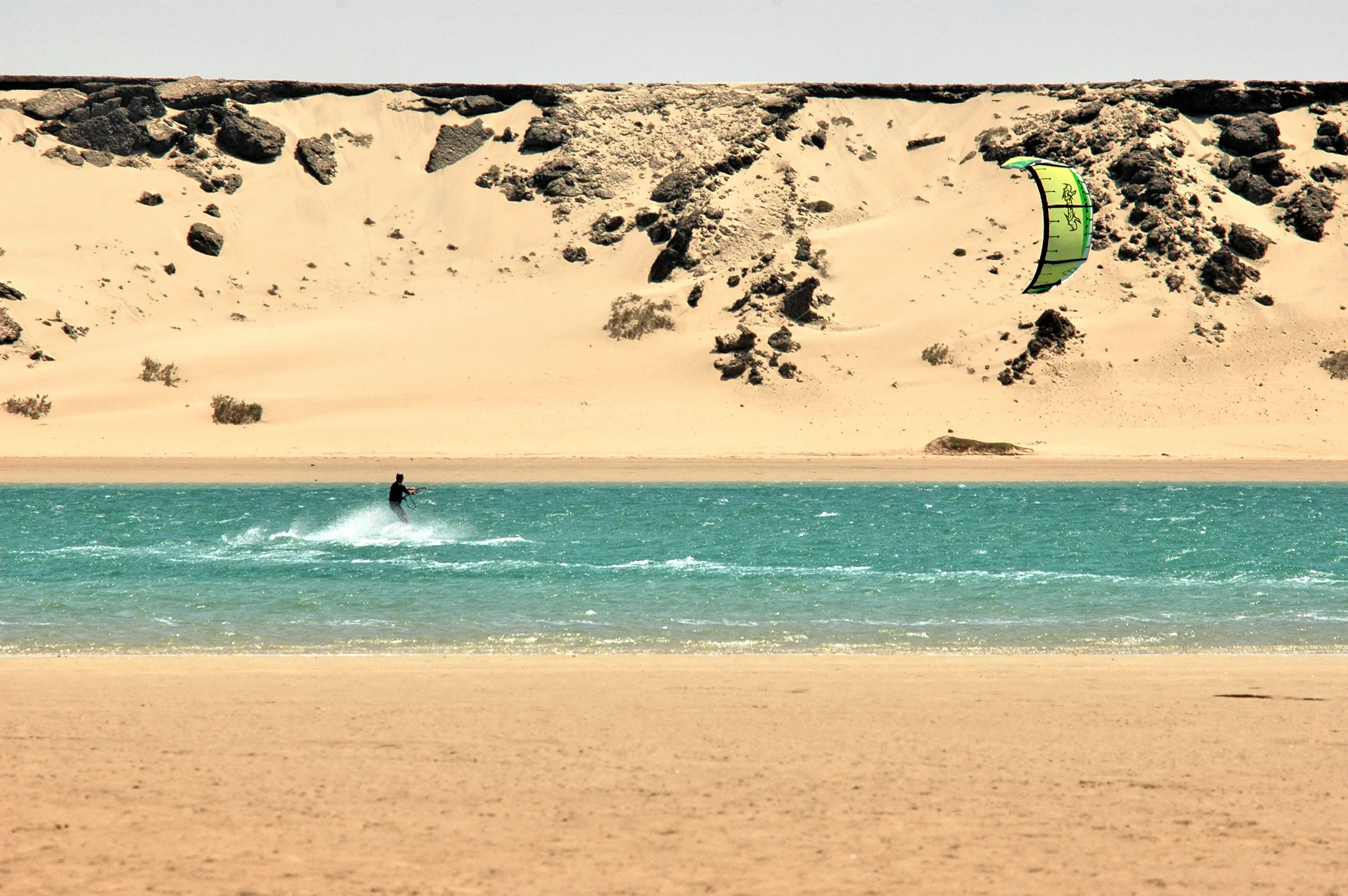
Worth saying plainly: it's a destination, not a session. You ride there, you have your moment, you get picked up. If you're after four solid hours on the water, do that at the lagoon and treat the dune as the excursion it is.
Foum Labouir is the main wave spot for kitesurfing in Dakhla, a long Atlantic beach about fifteen minutes from Dakhla city. It produces straight, long waves, works best from October to May, and suits intermediate and advanced riders who want to ride strapless or in surf.
When people ask where to kitesurf in Dakhla in the waves, this is the answer.
It's also a forgiving place to start. The waves are well-mannered by Atlantic standards, and they break for long enough that you get more than one attempt at reading them. It's hosted stops on the GKA strapless world tour, which tells you the ceiling is high even if the entry level isn't. I expected it to feel more serious because of that reputation. In reality, it felt surprisingly approachable.
You'll also see it spelled Oum Lbouer, that's how it comes up on Google Maps, which is useful to know when you're trying to explain to a driver where you want to go.
The wind here behaves differently from the lagoon, and this is the part that catches people out. It runs a few knots lighter than the lagoon and gets properly gusty inside the bay itself. Head a little further out, and it steadies up, but it never feels as clean as the flat water back home at camp.
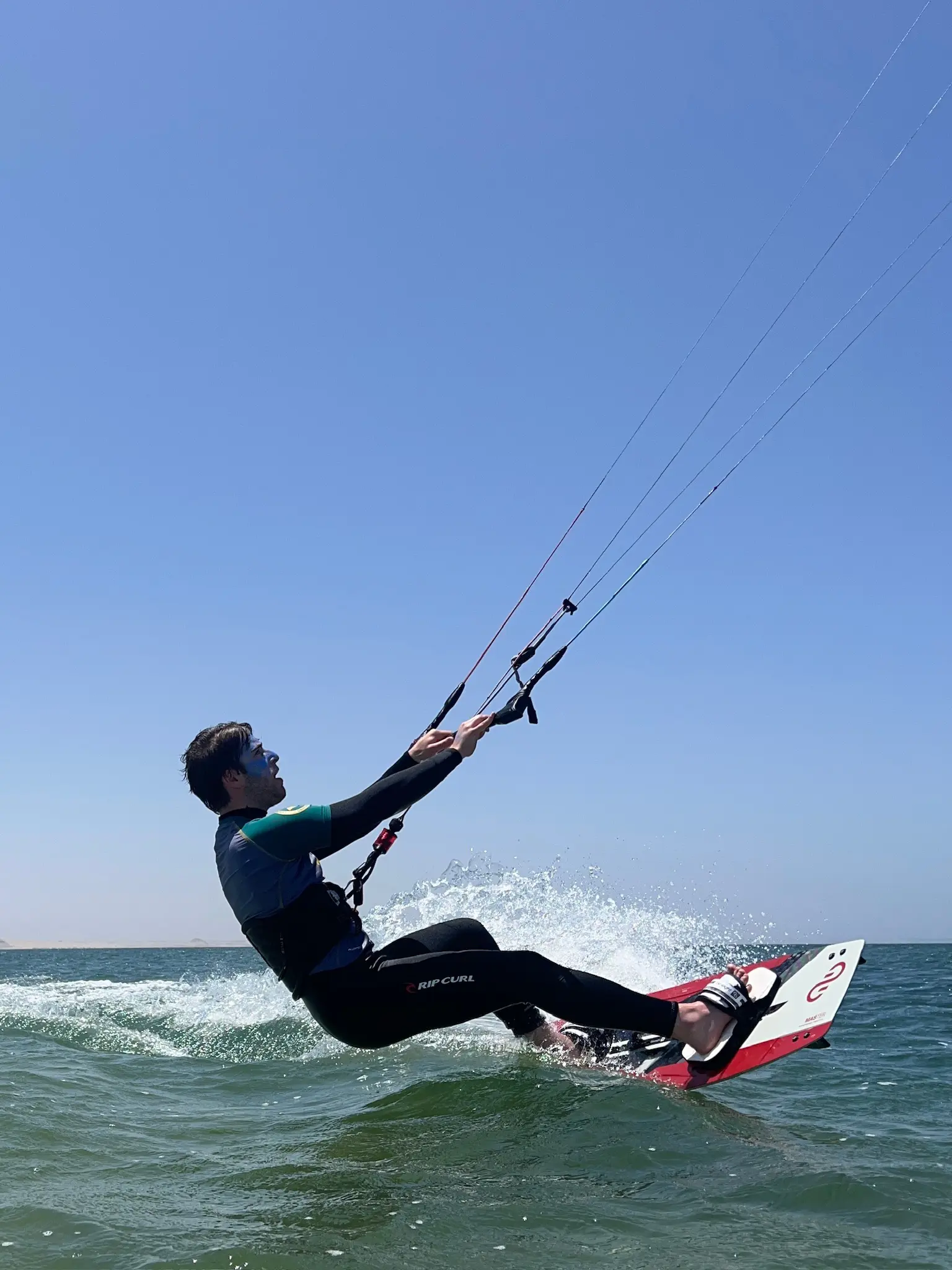
The first time I rode there, I kept wondering why my kite didn't feel quite right. It wasn't my imagination. The wind really does feel different from what you've been riding on the lagoon. Size up accordingly.
That wave window sits across the shoulder and off-season months, and within it, October and March are the sweet spots. Enough swell to be worth the trip, enough wind to still be kiting rather than swimming.
La Sarga is a wave spot at the tip of the Dakhla peninsula where the lagoon meets the Atlantic, known for long right-hand waves peeling down a sandy point. It rides as a wave spot from October to March and flattens out into a freestyle spot from March to October.
Also written Lassarga, it's a small fishing village at the point where the two bodies of water meet.
They're right-handers, which if you're a natural-footer makes for a very good day out, and they run long enough that you can actually work a wave rather than just survive it. What surprised me most is how completely the place changes with the calendar. Turn up in July, and you'd never guess it's a wave spot at all.
The first time someone told me that, I thought they were exaggerating. Then I saw photos from different times of year and realised they weren't kidding. It really does feel like two different spots.
It's less organised than the lagoon, and that's the appeal. Fishing boats, a bit of dust, nobody managing anything. It feels a little rough around the edges, and I actually liked that.
After a few days at the bigger camps, it was nice to spend a session somewhere that felt quieter and less busy. I like it a lot, though I'd add that if something goes wrong out there, you're a long way from a rescue boat, so it's not the place to push into conditions you're unsure about. I'd rather finish the day wishing I'd pushed a little harder than wishing I hadn't.
A few places on the peninsula aren't really riding spots, but keep coming up, so it's worth being straight about them.
Dragon Island is a sand-and-rock outcrop that looks like a sleeping dragon from the side. At low tide, you can walk or wade out to it and climb up for a genuinely excellent panorama over the lagoon. It's a rest-day trip rather than a session, and the ground is thick with shells, so wear something on your feet. Don't make the mistake of thinking flip-flops are enough. Those shells are surprisingly sharp, and you'll notice pretty quickly if you forget.
The oyster farm and the grass flats further down the lagoon are shallow, quiet, and reachable on a downwinder at low tide. Very flat, very empty, tall grass growing out of the water in places. Flamingos, sometimes. They're lovely, and they're also fiddly to reach and easy to get stranded at, which is why almost everyone does them with a guide. It was one of the quietest sessions I had all week. At one point I remember looking around and wondering where everybody else had gone.
Pointe d'Or is an ocean-side rocky point with a proper big-wave bay. You need a 4x4 to get there because the sand swallows anything else, and you need real wave experience to ride it. Most visitors will admire it from the beach, and that's the right call. I never felt like I was missing out by staying on shore there. Watching riders who actually know what they're doing is entertaining enough.
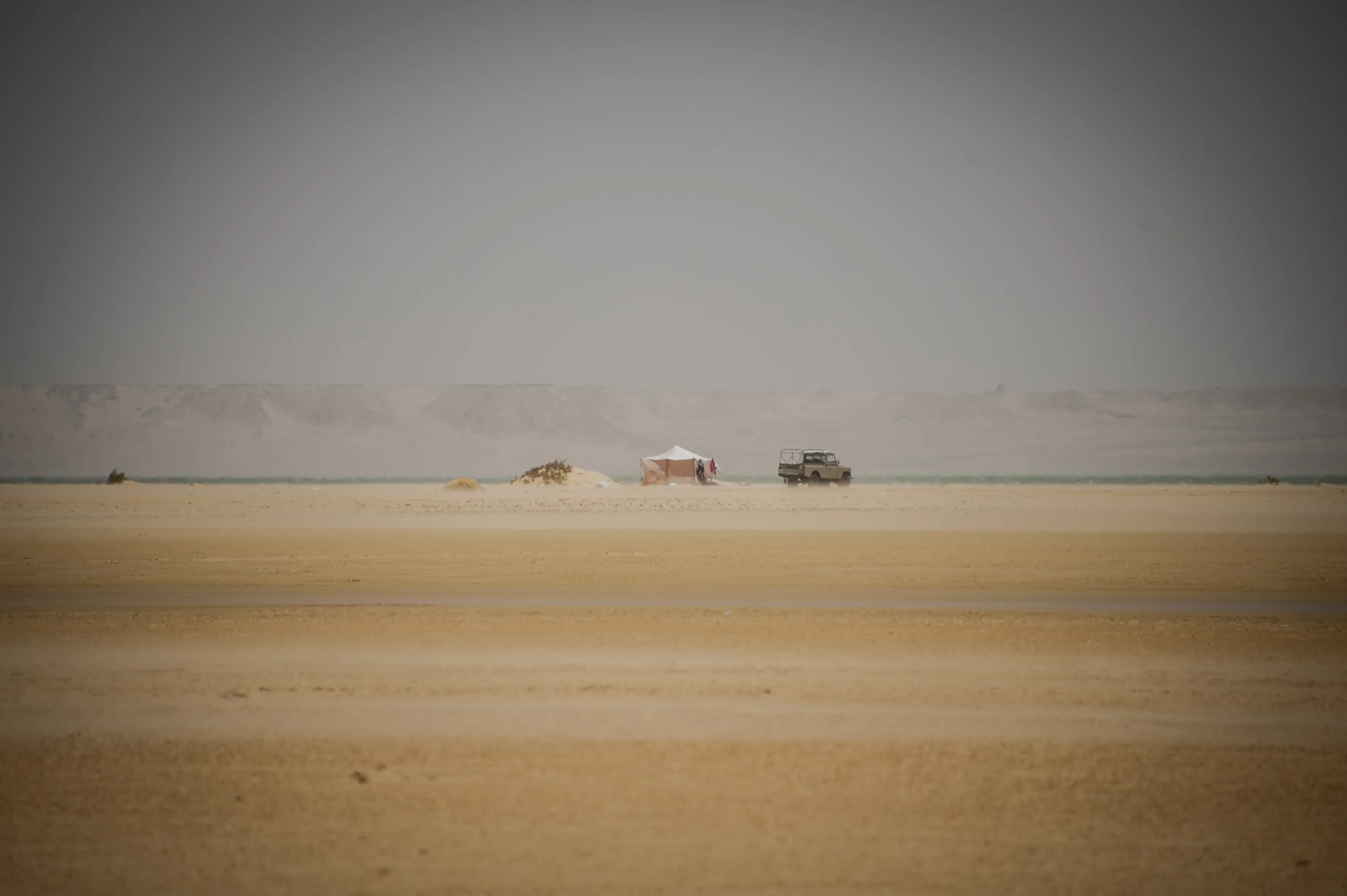
The downwinder is Dakhla's signature session, and it's really just the spots joined together by a north-easterly.
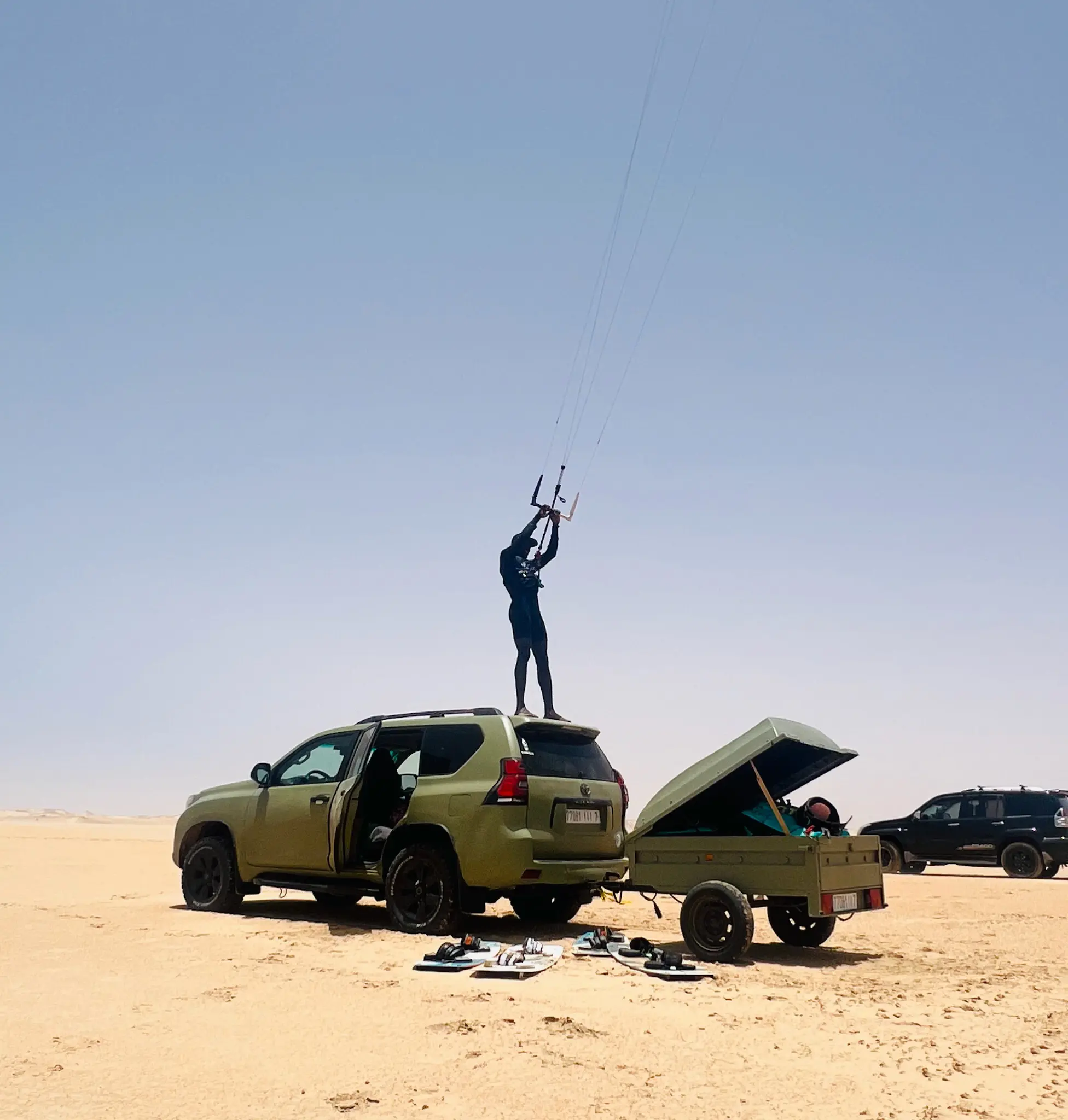
The standard run goes from the lagoon to the Speed Spot or the White Dune, somewhere in the region of 10 to 20 kilometres. Camps run longer versions of 30 to 40 kilometres for people who want them, with a boat shadowing the group and a 4x4 on the beach carrying water, snacks, and spare gear.
You need to be able to ride upwind confidently and self-rescue before anyone will take you, and that's a reasonable bar rather than gatekeeping. There's no walk of shame back to the car on a downwinder, if you can't ride, you're getting picked up out of the water somewhere remote. It sounds obvious when someone explains it, but I hadn't really thought about just how far from camp you end up until I did my first one.
Don't do one alone. The logistics are the entire safety plan, and they're the reason it works. The support crew isn't just there to make life easier. They're a big part of what makes these trips possible in the first place.
The honest answer for most trips is "the lagoon, mostly, plus one or two excursions." But here's how I'd break it down.
Beginners and anyone in their first few weeks should stay on the lagoon and not feel any pressure about it. The shallow water and the space are doing real work for your progression, and the excursion spots will still be there next trip. I remember feeling slightly left out when a group headed off on a downwinder in my first week, then being very glad I'd stayed once I heard how the day went. Looking back, I probably learned more by spending another day on the lagoon than I would have by trying to squeeze in another destination.
Improving intermediates get the most out of Dakhla, honestly. You can do your mileage on the lagoon, then use the Speed Spot on a good low tide to try the things you'd never risk in chop. That combination is hard to find anywhere else. That's probably the stage where Dakhla made the most sense to me. Everything felt just challenging enough without becoming frustrating.
Freestylers should plan the trip around the tide table rather than the calendar. The Speed Spot at low water is the whole point, so work out when those windows fall and book accordingly. It sounds a bit obsessive until you've missed a good tide. Then you understand why everyone keeps checking the timetable.
Wave riders should look at October, March, or April rather than midsummer. Peak season has the strongest wind, but the ocean side is at its best when the swell is running and the wind has backed off a bit. If waves are your priority, I'd happily trade a little wind for better swell.
Anyone chasing scenery over performance should book one downwinder to the White Dune and stop worrying about the rest. Even if you're not the type who stops for photos, there's a good chance you'll make an exception there. It's the memory you're actually paying for.
If you take one practical thing from this, make it this one.
The tidal range here runs up to around 2.5 metres, which is enough to completely change what's on and what isn't. The Speed Spot needs low water. The White Dune needs high water. The lower lagoon flats need low water and a plan for getting home. The main lagoon works throughout, which is another quiet argument for basing yourself there.
I didn't really appreciate how much the tide mattered until I was there. At home, I mostly think about the wind. In Dakhla, both matter, and sometimes the tide wins.
Camps post the tide times, and it's worth glancing at them on your first morning rather than your last. I've learned that the hard way more than once. It takes about thirty seconds to check, and it can save you wasting half a day.
One more practical note: the wind sizing is fairly predictable across all of these. In peak season, riders are typically on 6 to 8-metre kites in 25 to 35 knots, and you'll want a size up for the ocean side, where it blows a little lighter than the lagoon.
If you're renting, that's not a big deal. If you've packed your own gear, it's something I'd think about before the trip.
If it were my first week here, I'd spend five days on the lagoon and not apologise for it. Get the mileage in, get comfortable in the side-shore, and let the place become familiar.
Then I'd watch the tide table and take one downwinder. The White Dune if the high water falls in the afternoon, the Speed Spot if it's low. And if there's swell and I had the days to spare, one morning at Foum Labouir to remind myself that flat water isn't the only thing on offer.
The trap is trying to tick off all six. I've met people who spent more of their week in a 4x4 than on the water, and they didn't have a better trip than the ones who stayed put and rode.
It's easy to fall into that holiday mindset where you think seeing more automatically means having a better trip. I don't think that's true here. Most people leave happiest after a week of good sessions, not a week of rushing between spots.
Not sure which spots suit your level or when to time your trip around the tides? Get in touch with us, and we'd love to help you plan it.